
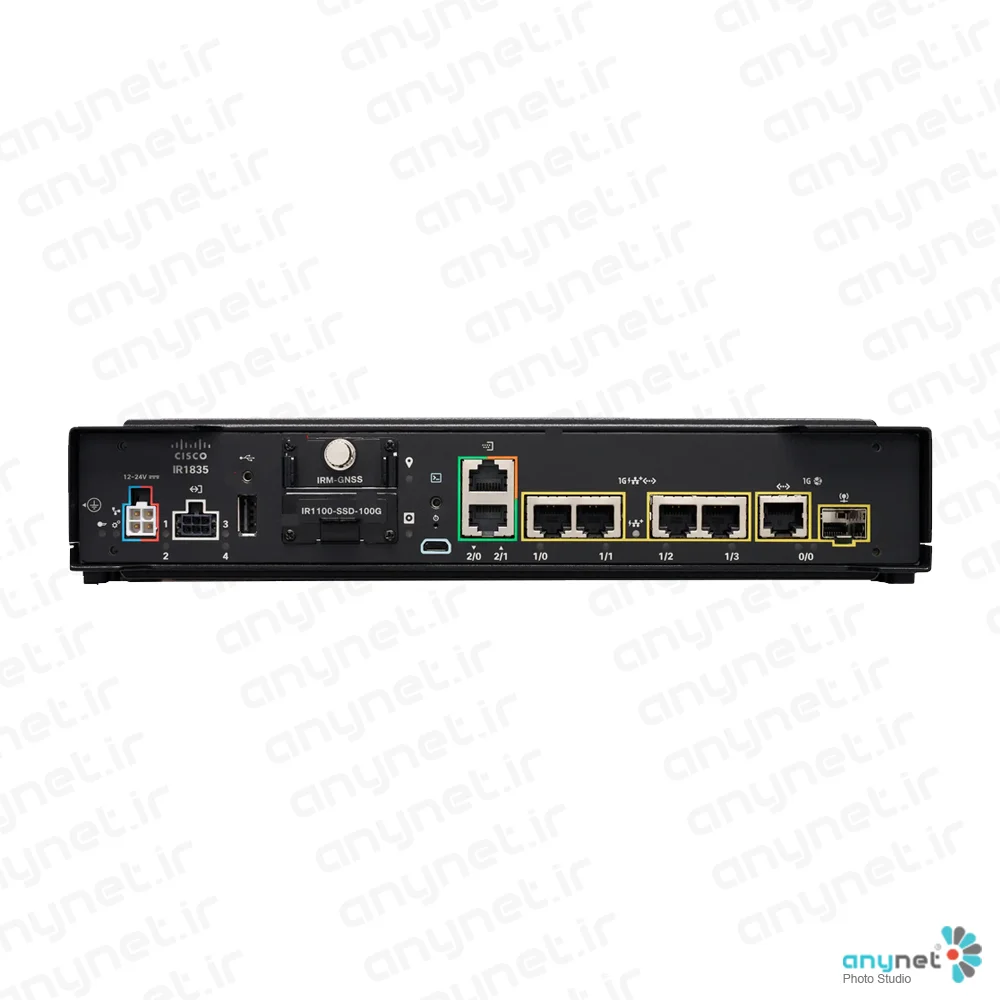

Cisco IR1835-K9 Industrial Router
-
: IR1835-K9
-
: Cisco Catalyst IR1835 Rugged Series Router
-
: 3,015.00: 2021-08-09
- اطلاعات مربوط به تاریخ های پایان فروش و پایان پشتیبانی فنی (EOL/EOS - End-of-Sale and End-of-Life)
- تاریخ معرفی محصول:
- تاریخ پایان فروش:
- تاریخ پایان پشتیبانی:
Introduction
The Cisco Catalyst IR1800 Rugged Series routers represent a significant leap forward in industrial networking, specifically engineered to meet the rigorous demands of mobile and stationary deployments in harsh environments. As industries continue to embrace digital transformation, the need for reliable, high-performance connectivity at the edge has become paramount. These routers are designed to bridge the gap between traditional enterprise networks and the challenging conditions found in sectors such as transportation, utilities, public safety, and manufacturing. By integrating advanced routing capabilities with modular hardware, Cisco provides a robust foundation for mission-critical applications that require constant uptime and secure data transmission.
These devices are built to withstand extreme temperatures, vibrations, and electromagnetic interference, ensuring that operations remain uninterrupted regardless of the physical setting. The series is not merely about connectivity; it is about providing a comprehensive platform that supports edge computing, advanced security, and seamless integration with existing IT infrastructures. By leveraging the power of Cisco IOS XE, the IR1800 series offers a consistent operating system experience, simplifying management and deployment across distributed networks. This approach allows organizations to scale their operations efficiently while maintaining the high standards of performance and reliability expected from Cisco’s enterprise-grade solutions.
Furthermore, the architecture of the Catalyst IR1800 series emphasizes flexibility and future-proofing. As network requirements evolve, the modular nature of these routers allows for hardware upgrades and the addition of new interfaces without the need for a complete system overhaul. This adaptability is crucial for businesses looking to protect their long-term investments while staying ahead of technological advancements. Whether deployed in a police vehicle, a remote substation, or a factory floor, the IR1800 series serves as a versatile and resilient hub that empowers organizations to harness the full potential of their data, ultimately driving operational efficiency and enabling smarter decision-making in real-time.
Product overview
The Cisco Catalyst IR1800 Rugged Series consists of several distinct models, each tailored to specific deployment scenarios while sharing a common core of high-performance hardware. The primary models include the IR1821, IR1831, IR1833, and IR1835. These routers are designed to be modular, allowing users to select the specific connectivity options—such as 5G, Wi-Fi 6, or additional Ethernet ports—that best suit their unique operational needs. The IR1821 serves as the base model, offering a solid foundation for standard industrial routing, while the IR1831 and IR1833 models introduce more advanced capabilities, including enhanced processing power and additional expansion slots for specialized modules. The IR1835 stands out as the most feature-rich option, providing maximum flexibility for complex, high-bandwidth applications.
Central to the product line is the integration of Cisco’s software-defined networking capabilities. By utilizing Cisco DNA Center, administrators can automate the provisioning, monitoring, and troubleshooting of these routers from a centralized dashboard. This centralized management is a game-changer for organizations with geographically dispersed assets, as it significantly reduces the time and cost associated with manual configuration. The hardware itself is housed in a ruggedized, fanless chassis that is IP30 rated, ensuring protection against dust and debris. This design choice is critical for industrial environments where maintenance access is limited and equipment failure can lead to costly downtime.
Beyond the physical hardware, the IR1800 series is deeply integrated with Cisco’s security ecosystem. The routers support advanced encryption, firewalling, and threat detection mechanisms that protect data as it moves from the edge to the cloud. This security-first approach is essential for modern industrial networks that are increasingly targeted by cyber threats. By combining high-speed connectivity with robust security and ease of management, the Catalyst IR1800 series provides a holistic solution for the modern industrial edge. It effectively transforms how organizations manage their remote assets, turning previously isolated data points into actionable insights that drive business value and operational excellence across the entire enterprise.
Features and benefits
- High-speed 5G and Wi-Fi 6 support ensures ultra-reliable, low-latency connectivity for mobile and remote industrial applications.
- Modular design allows for field-replaceable modules, enabling organizations to upgrade interfaces like GPS, serial ports, or additional cellular modems without replacing the entire router.
- Cisco IOS XE operating system provides a consistent, programmable, and secure software environment that simplifies network management and automation.
- Ruggedized, fanless hardware construction is built to withstand extreme temperature fluctuations, high vibration, and shock, making it ideal for deployment in vehicles and outdoor cabinets.
- Integrated security features, including Cisco Trust Anchor technology and advanced encryption, protect sensitive data and prevent unauthorized access at the network edge.
- Support for Cisco DNA Center enables centralized, software-defined management, which reduces operational complexity and accelerates the deployment of new services.
- Edge computing capabilities allow for the local processing of data, reducing the need to send large volumes of information to the cloud and improving response times for critical applications.
- Comprehensive power management options, including support for Power over Ethernet (PoE), allow the routers to power connected devices like cameras and sensors directly, simplifying installation.
- Advanced GPS and location tracking features provide real-time visibility into the location of mobile assets, which is vital for fleet management and public safety operations.
- Long-term lifecycle support and hardware reliability ensure a lower total cost of ownership and protect the organization’s investment against rapid technological obsolescence.
Cisco Catalyst IR1800 Rugged Series Routers deliver performance, security, and flexibility to help you accelerate your digitization journey at the edge.
Product overview
Cisco Catalyst IR1800 Rugged Series Routers are Cisco IoT’s most versatile routers, offering
advanced security capabilities such as Next-Generation Firewall (NGFW). They deliver secure, high-performance, 5G routers in a modular design that support private LTE, FirstNet, Verizon Frontline, Wi-Fi6 and Gigabit Ethernet. Designed with a high level of modularity, they can be customized to help you reduce costs and make your networking investments ready for the future, keeping in mind the needs of tomorrow. With high bandwidth and throughputs from 5G and Wi-Fi 6, they enable you to connect all your assets, converge networks and drive efficiency.
The Catalyst IR1800 Series offers enterprise-grade security from the hardware to the network communications all the way to the industrial assets. The routers are powered by Cisco IOS ® XE, Cisco’s fully programmable next-generation operating system.
Scale and simplify operations at the edge with powerful network management tools such as Cisco SD-WAN Manager and Cisco Catalyst Center for configuration, monitoring, and troubleshooting.
IR1800 supports Cisco ThousandEyes Assurance, allowing you to proactively monitor your network with end-to-end visibility all the way to the industrial edge, and Cisco Cyber Vision, for discovery of everything connected to your industrial network, assessment of OT security posture, and adaptive network segmentation to drive efficient OT security at scale.
The IR1800 Series is built to withstand the harsh environments found in remote and harsh places renewable energy, remote. by providing reliable, rugged connectivity for stationary assets such as oil and gas equipment, solar and wind farms, ATM machines and EV charging stations.

Product Highlights
Use cases
Oil and gas
Monitor pipelines, adjust valve pressure, optimize production, and prevent unplanned downtime.
Enable machine visibility and equipment monitoring to prevent faults before they occur while reducing costs.
Roadways and intersections
Highways and transportation agencies require reliable networks to connect speed cameras, monitoring cameras and more using backhaul technologies such as 4G and 5G with secure remote access capabilities to remotely maintain equipment.
Renewable energy production
Collect telemetry, monitor operations, detect incidents, easily gain remote access to control equipment, and ensure physical security in remote locations while leveraging cellular networks to simply connect individual wind turbines and solar panels.
EV chargers
With the risks of broken hardware, unexpected shutoffs, payment problems and more, you need reliable connectivity to your EV infrastructure to monitor and maintain equipment remotely to quickly resolve issues and reduce truck rolls to deliver a seamless customer experience.
Connected machines
Whether you’re dealing with heavy industrial machinery or remote systems such as ATMs, kiosks, and vending machines, you need connectivity for the machine to access business applications or just to troubleshoot issues and maintain uptimes.
Mining
Connect light duty trucks and other assets using a combination of private cellular networks and Wi-Fi due to spotty public cellular coverage and need for cost-effective high throughput connectivity for high bandwidth applications such as video and file transfers and on-board connectivity for fleets.
Features and benefits
Key features and benefits
Table 1. Features and benefits
|
Feature |
Benefit |
|
Reliable connectivity for mission-critical mobile environments |
● The modular IR1800 with dual cellular slots is capable of running multiple cellular services at once for mission-critical applications, allowing dual cellular band redundancy.
● Supports modular IEEE 802.11ax Wi-Fi 6. The dual-radio Wi-Fi (2.4 and 5 GHz) can provide access point capability and also backhaul capability (in a stationary condition) to connect to infrastructure Wi-Fi.
|
|
Modular design |
● Ultra-modular design supports evolving business and technical needs, protecting your investment.
● Supports multiple different modules, including public or private 4G/LTE and 5G, Wi-Fi 6, FirstNet certified public safety LTE, SSD, and advanced GNSS, thus providing a high level of flexibility to choose the desired configuration to suit individual deployments.
|
|
Security |
● Provides end-to-end multilayer enterprise-grade security that is part of Cisco’s ultra-secure and advanced Cisco IOS XE operating system.
● For added security, the IR1800 supports advanced enterprise-grade security suites such as unified threat detection for deployments requiring a higher level of enterprise-class security.
● Supports Cisco Cyber Vision, providing visibility into industrial assets connected to the router.
|
|
Edge computing |
● Comes with built-in edge compute resources and Cisco IOx App hosting support to securely run your own applications at the edge.
● Supports Cisco’s Edge Intelligence suite to unlock business intelligence.
|
|
Integrated storage |
● Provides support to expand the internal storage to save multimedia and mission-critical data at the edge with its field-replaceable industrial-grade SSD.
|
|
SD-WAN |
● Supports Cisco IOS XE SD-WAN technology to effectively manage hundreds of disparate locations, lowering TCO and operating at scale.
● Support advanced SD-WAN security on IR1835 with 8GB memory.
|
|
ThousandEyes Assurance |
● Proactively monitor OT asset network connectivity health and improve operational resilience with end-to-end network visibility
|
|
Public Safety Certifications |
● FirstNet Capable
● Verizon Frontline
|
Prominent features
Cisco Catalyst IR1800 Rugged Series Routers portfolio
Cisco Catalyst IR1800 Rugged Series Routers are best-in-class ruggedized routers designed for assets that are mobile or on the move, stationary or remote. These highly flexible and modular routers are 5G ready and adopt the latest Wi-Fi 6 standards. The IR1800 Series consists of the following models: IR1833-K9, and IR1835-K9.
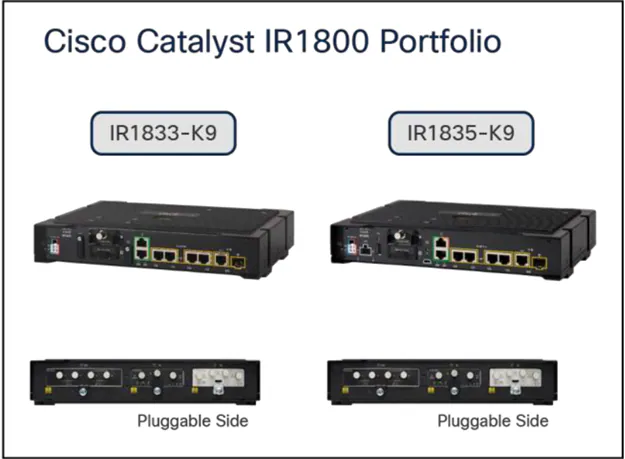
Models in the Catalyst IR1800 Series
The table below explains the top-level features of the models in the IR1800 Series
Table 2. Comparison of key features
|
Feature |
IR1833-K9 |
IR1835-K9 |
|
Memory |
4 GB |
8 GB |
|
Pluggable slots (cellular) |
2 |
2 |
|
Wide pluggable slot (Wi-Fi) |
1 |
1 |
|
Ignition power management |
✓ |
✓ |
|
Gigabit Ethernet (GE) LAN (x4) |
✓ |
✓ |
|
Combo RJ-45/SFP GE WAN port (L3) (x1) |
✓ |
✓ |
|
Micro USB console |
✓ |
✓ |
|
Power over Ethernet (PoE)/PoE+ |
✓ |
✓ |
|
SSD slot |
✓ |
✓ |
|
Automotive dead reckoning GNSS slot |
✓ |
✓ |
|
Digital I/O (x4) |
- |
✓ |
|
Serial interface |
RS-232 (2) |
RS-232 (1), RS-232/485 (1) |
Placement of IR1800 interface ports
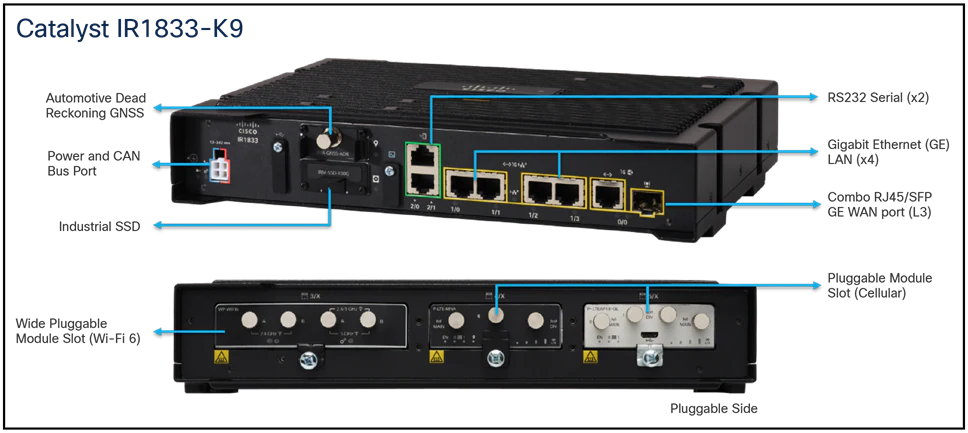
IR1833-K9 interface ports
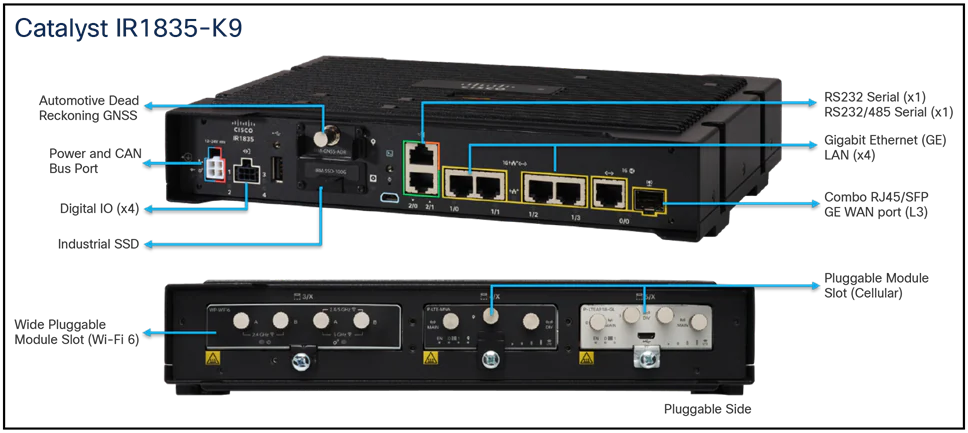
IR1835-K9 interface ports
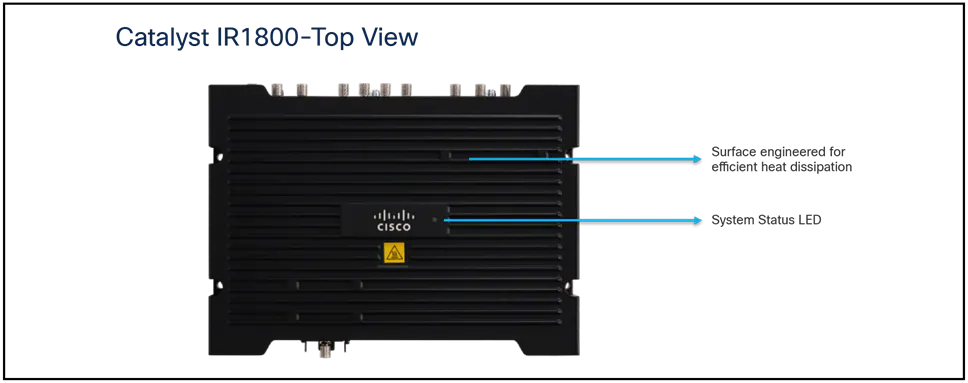
Top view
The Catalyst IR1800 Series also introduces Wi-Fi 6 in a pluggable form factor. This ruggedized wide pluggable module provides the latest in Wi-Fi technology and is compatible with the latest wireless controllers from Cisco. The module can run in Control and Provisioning of Wireless Access Points (CAPWAP) mode and Embedded Wireless Controller (EWC) mode, as well as Work Group Bridge (WGB) mode.
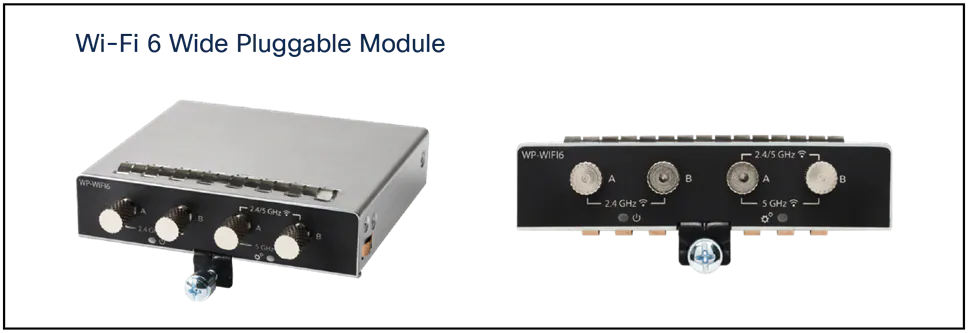
Wi-Fi 6 wide pluggable module
The Catalyst IR1800 Wi-Fi 6 supports the following deployment scenarios and modes.
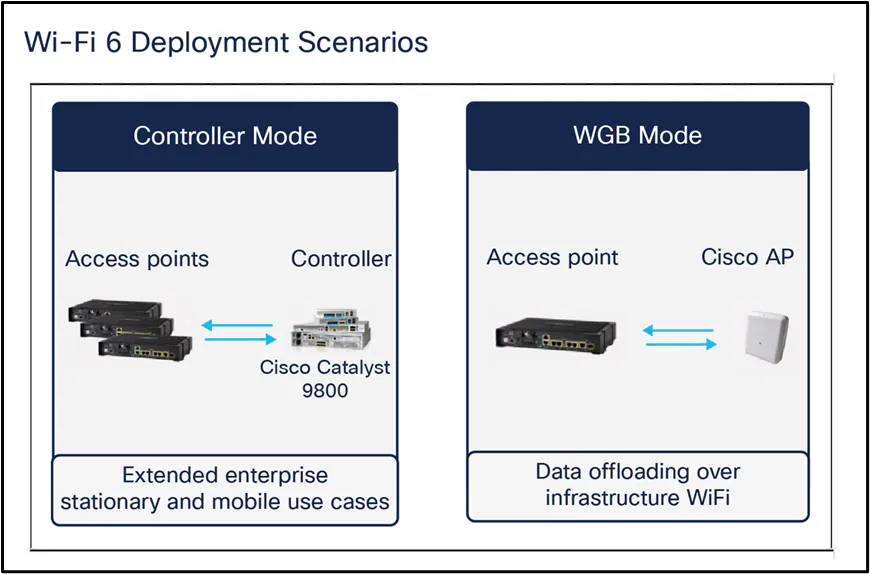
Wi-Fi 6 deployment scenarios
Memory specifications
Table 3. Memory specifications
|
Feature |
Specification |
|
Default and maximum DRAM |
● 4 GB (IR1833)
● 8 GB (IR1835)
|
|
Default and maximum flash memory |
● 4 GB (IR1833)
● 8 GB (IR1835)
|
|
Expandable SSD storage |
● Cisco’s industrial-grade field-replaceable 100-GB storage (IRM-SSD-100G)
|
|
Backup flash storage |
● Provides an added layer of protection from improper shutdown cycles, thus preventing any kind of memory corruptions.
|
Physical Specifications
Table 4. Physical specifications
|
Feature |
Specification |
|
Physical dimensions |
● 2.20 x 11.04 x 8.06 in. (55.9 x 280.4 x 204.7 mm)
● 2.20 x 11.04 x 9.73 in. (55.9 x 280.4 x 247.0 mm) with additional IP54-KIT
(IR1800-IP54-KIT) |
|
Weight |
● 2.4 kg (5.3 lb) (without any modules)
● 3.1 kg (6.8 lb) (fully configured)
|
|
IP rating |
● IP40 rated
● IP54 rated with additional IP54-KIT (IR1800-IP54-KIT)
|
|
Mounting options |
● DIN rail
● Panel mount
|
Power Specifications
Table 5. Power specifications
|
Feature |
Specification |
|
Power input |
● Nominal voltage: +12V and +24V
● Minimum and maximum input voltage: 9V - 36V
● Maximum and Minimum input current: 7.56A - 1.99A
|
|
Power consumption |
● At idle: 16W (at 12V), 17W (at 24V)
● Typical: 22W (at 12V), 23W (at 24V)
● Maximum: 27W (without PoE), 71W (with PoE)
|
Interfaces
Table 6. Interfaces
|
Feature |
Specification |
|
WAN interfaces |
● Pluggable Interface Module slots
◦ 2x for Cisco Cellular Pluggable Interface Modules ● Wide interface pluggable module slots-
◦ 1x on all IR1800 models for Cisco Wi-Fi 6 Wide Interface Pluggable Module ● Combo 10/100/1000 Mbps Ethernet port (RJ-45 and SFP) (1x on all IR1800 models)
|
|
LAN interfaces |
● 4x 10/100/1000 Mbps RJ-45 Ethernet ports
|
|
Asynchronous serial interfaces |
● IR1833: 1x RS-232 DTE port and 1x RS-232 DCE port
● IR1835: 1x RS-232 DTE port and 1x RS-232 DCE/RS-422/RS-485 port
|
|
Console |
● 1 micro-USB port
|
|
Automotive dead reckoning GNSS |
● IR1833, IR1835: 1x slot for automotive dead reckoning GNSS module (IRM-GNSS-ADR)
|
|
Expandable storage |
● IR1833, IR1835: 1x slot for Cisco’s industrial 100-GB SSD (IRM-SSD-100G)
|
|
Power input/CAN bus combo |
● 4-pin Molex Mini-Fit port for power and CAN bus (see accessories for more details)
|
|
Digital I/O |
● IR1835: 4x digital I/O ports
|
|
Ignition power management |
● All IR1800 models have automatic ignition power management capability for Ignition sense.
● IR1835 supports Ignition power management with Ignition signal switching.
|
|
USB port |
● 1x USB 2.0 Type A
|
|
Status LEDs |
● Top surface
◦ 1x system status LED ● Front surface
◦ 1x ignition power management LED ◦ 1x system status LED ◦ 4x Gigabit Ethernet LEDs ◦ 2x Combo Gigabit Ethernet-SFP LEDs ◦ IR1833, IR1835: 1x expandable storage LED ◦ IR1833, IR1835: 1x automotive dead reckoning GNSS LED ◦ IR1835: 4x digital I/O LEDs ● Cellular and Wi-Fi modules have power and status LEDs on the modules
|
Environmental specifications
Table 7. Environmental specifications
|
Feature |
Specification |
|
Environmental operating temperature range |
● –40° to 140°F (–40° to 60°C) in a sealed NEMA cabinet with no airflow
● –40° to 158°F (–40° to 70°C) in a vented cabinet with 40 linear feet per minute (LFM) of air
● –40° to 167°F (–40° to 75°C) in a forced air enclosure with 200 LFM of air
● Type tested at 85°C for 16 hours
● Refer to the IR1800 Hardware Installation Guide (HIG) for the operating temperature range for pluggable cellular modules and wide pluggable Wi-Fi modules
|
|
Operating altitude |
● Maximum altitude: 13.800 ft per IEC 68-2-41
|
Standards and industry specifications
Table 8. Standards and industry specifications
|
Feature |
Specification |
|
Mechanical |
● SAE J1455 (Automobile Standard)
● Temperature cycle stress test
● Active 10-day temperature and humidity test
● MIL STD 810G (Military Standard)
● Method 514.6, Category 4 – Random Vibration
● Method 516.6, Procedure V – Crash Hazard Shock
● Method 516.6, Procedure I – Functional Shock
|
|
Automotive |
● UNECE R10
● CISPR25
● ISO 7637 – 2
● ISO 11452 – 2/4
● EN 50155 2007/2017/2021, EN 50121-3-2:2016 & EN 50121-4: 2016
● EN 50125-1:2015, EN 50125-3:2003
● EN 45545-2:2020
|
|
Hazardous locations and ITE safety |
● UL 121201 (Class l, Div. 2, groups A-D)
● CSA 213 (Class l, Div. 2, groups A-D)
● UL/CSA 60079-0, -15 (Class l, Zone 2, Gc/IIC)
● IEC 60079-0, 7 -15 IECEx test report (Class l, Zone 2, Gc/IIC)
● EN 60079-0, 7, 15 ATEX certificate (Class l, Zone 2, Gc/IIC)
● UL/CSA 60950-1
● UL/CSA 62368-1
● IEC/EN 60950-1
● IEC/EN 62368-1
|
|
EMC |
● FCC part 47 CFR Part 15 Subpart B Class A
● EN 5032/CISPR 32 Class A
● VCCI Class A, AS/NZS CISPR 32 Class A
● CISPR 11 Class A, ICES 003 Class A
● CNS 13438 Class A, KN 32 Class A
● EN 300 386
● CISPR35/EN 55035
● EN/IEC61000-4-2 (ESD - Air/Contact Charge)
● EN/IEC61000-4-3 (Radiated Immunity)
● EN/IEC61000-4-4 (Electro Fast Transients Burst)
● EN/IEC61000-4-5 (Surge)
● EN/IEC61000-4-6 (Conducted Immunity)
● EN/IEC61000-4-8 (Power Frequency Magnetic Field Immunity)
● EN/IEC61000-4-9 (Pulse Magnetic Field Immunity)
● EN/IEC61000-4-11 (Voltage Disturbance Immunity)
|
|
Radio (cellular) |
● FCC 47 CFR Part 22,24,27
● FCC 47 CFR Part 2 MPE
● RSS 102, 132, 133
● AS/NZ: ACMA EMR, AS/CA S042.1, 4
● Japan MIC Article 2, 9
● EN 301 489-1,19,52
● EN 301 908-1,2,13
● EN 301 511
● EN 303 413
● EN 62311 MPE
|
|
Radio (Wi-Fi) |
● FCC CFR Part 15.247, 15.407
● RSS 247 Issues 5
● EN 300 328, EN 301 893
● AS/NZ 4268:2018
● 2018.7 (MSIT notice 2018-38), 2017.9 (MSIT notice # 2017-10)
● NOTACNCANEH N° 14/2013, NOTACNCANEH N° 14/2013
● Act n° 14448 (2017-12-04)
● MIIT R-2002-353, MIIT R-2002-277, MIIT R-2012-620
● LP0002;2018
● Resolution 1985/2017 + Res. 1517/2018 + Res. 855/2019
|
IR1800-Compatible Pluggable Modules
Table 9a LTE (3GPP Category 4) Modules Available with IR1800
|
Features |
P-LTE-GB |
|
Countries / Regions |
Europe |
|
LTE Bands |
LTE Bands B1, B3, B7, B8, B20, B28 FDD LTE 700 MHz (B28), 800 MHz (B20), 900 MHz (B8), 1800 MHz (B3), 2100 MHz (B1), and 2600 MHz (B7) |
|
Backward Compatibility |
UMTS, HSPA+ (B1, B8), EDGE, GSM, GPRS (900/1800) |
|
Theoretical Download and Upload Speeds1 |
150 / 50 Mbps |
|
Carrier(s) Certified |
Europe - Generic Carrier Firmware (GCF) |
|
FirstNet Capable™ (B14) |
– |
Table 9b. LTE Advanced (3GPP Category 7) Modules Available with IR1800
|
Features |
P-LTEA7-NA |
P-LTEA7-EAL |
P-LTEA7-JP |
|
Countries / Regions |
United States, Canada, North America |
Europe, LATAM, Australia, New Zealand, India, Singapore, Malaysia, United Arab Emirates |
Japan |
|
LTE Bands |
B2, B4, B5, B7, B12, B13, B14, B25, B26, B41, B42, B43, B48, B66, B71 |
B1, B3, B7, B8, B20, B28, B32, B38, B40, B41, B42, B43 |
B1, B3, B5, B8, B18, B19, B39, B41, B42, B43 |
|
3G HSPA+ Bands |
B2, B4, B5 |
B1, B5, B8 |
B1, B5, B6, B19 |
|
Theoretical Download and Upload Speeds1 |
300 Mbps / 150Mbps |
300 Mbps / 150Mbps |
300 Mbps / 150Mbps |
|
Carrier(s) Certified |
US - Verizon, AT&T, T-Mobile, PTCRB2 Canada - Rogers |
LATAM, Europe, APJC - Generic Carrier Firmware (GCF) |
- |
|
Carrier(s) Coming Soon |
Canada - Bell, Telus |
Australia - Telstra |
NTT Docomo, KDDI, Softbank |
|
FirstNet Capable™ (B14) |
Approved by AT&T FirstNet |
- |
- |
Table 9c 5G NR RedCap (3GPP Release 17) Modules Available with IR1800
|
Features |
P-5GS6-RC-GL |
|
Countries/Regions |
United States, Canada, LATAM, Europe, Australia, New Zealand, Japan, Hong Kong, Indonesia, Singapore, India, China |
|
RF Bands |
5G NR Sub-6 n1, n2, n3, n5, n7, n8, n12, n13, n14, n18, n20, n25, n26, n28, n30, n38, n40, n41, n48, n66, n70, n71, n77, n78, n79 LTE Bands B1, B2, B3, B4, B5, B7, B8, B12, B13, B14, B17, B18, B19, B20, B25, B26, B28, B30, B34, B38, B39, B40, B41, B42, B43, B48, B66, B70, B71, B106 |
|
Theoretical Download and Upload Speeds1 |
5G DL/UL: ~220 Mbps / ~120 Mbps LTE: DL/UL: ~195 Mbps / ~75 Mbps |
|
Carrier(s) Certified |
US - AT&T, T-mobile, PTCRB, Verizon LATAM, Europe, APJC - Generic Carrier Firmware (GCF) |
|
Carrier(s) Coming Soon |
Canada - Bell, Telus, Rogers Australia - Telstra Japan - NTT Docomo, KDDI |
|
FirstNet Capable™ (B14) |
Coming soon with AT&T FirstNet |
|
Frontline Capable™ (B13) |
Coming soon with Verizon Frontline |
|
eSIM SGP.32 Capable |
Supports GSMA SGP.32 remote SIM profile swaps OTA via 3FF removable eSIMs (eUICC) |
|
GPS/GNSS Capable |
ANT-3-5G2G1-P-O (3-1 antenna) ANT-GNSS-P-OUT-SMA (single port) Designed for passive GPS/GNSS antenna as part of low-power architecture. Active antennas requiring bias voltage are not supported. |
Table 9d Standalone / Non-Standalone 5G Sub 6 GHZ Module Available with IR1800
|
Features |
P-5GS6-R16SA-GL |
|
Countries / Regions |
United States, Canada, LATAM, Europe, Australia, New Zealand, Japan, Hong Kong, Indonesia, Singapore, India, China |
|
RF Bands |
5G FR1 n1, n2, n3, n5, n7, n8, n12, n13, n14, n18, n20, n25, n26, n28, n29-n30, n38, n40, n41, n48, n66, n70, n71, n75, n76, n77, n78, n79 LTE Bands B1, B2, B3, B4, B5, B7, B8, B12, B13, B14, B17, B18, B19, B20, B25, B26, B28, B29, B30, B32, B34, B38, B39, B40, B41, B42, B43, B46 (LAA), B48 (CBRS), B66, B71 |
|
Theoretical Download and Upload Speeds1 |
4.9 Gbps / 660 Mbps |
|
Carrier(s) Certified |
US - AT&T, Verizon, T-Mobile, PTCRB2 LATAM, Europe, APJC - Generic Carrier Firmware (GCF) |
|
Carrier(s) Coming Soon |
Canada - Bell, Telus, Rogers Australia - Telstra Japan - NTT Docomo, KDDI |
|
FirstNet Capable™ (B14) |
Approved by AT&T FirstNet |
Wi-Fi 6 pluggable module performance (support from Cisco IOS XE 17.6 onward)
Table 10. Wi-Fi 6 pluggable module performance
|
Feature |
WP-WIFI6 Wi-Fi performance |
|
Supported wireless LAN controllers |
● Cisco Catalyst 9800 Series Wireless Controllers
|
|
802.11ax capabilities |
● 2x2 uplink/downlink multiuser multiple-input multiple-output (MU-MIMO) with two spatial streams
● Uplink/downlink Orthogonal Frequency-Division Multiple Access (OFDMA)
● Target Wake Time (TWT)
● Basic Service Set (BSS) coloring
● Maximum Ratio Combining (MRC)
● 802.11ax beamforming
● 20-, 40-, and 80-MHz channels
● PHY data rates up to 1.488 Gbps (80 MHz with 5 GHz and 20 MHz with 2.4 GHz)
● Packet aggregation: Aggregate MAC Protocol Data Unit (A-MPDU) (transmit and receive), Aggregate MAC Service Data Unit (A-MSDU) (transmit and receive)
● 802.11 Dynamic Frequency Selection (DFS)
● Cyclic Shift Diversity (CSD) support
● Wi-Fi Protected Access 3 (WPA3) support
|
|
802.11ac capabilities |
● 2x2 downlink MU-MIMO with 2 spatial streams
● MRC
● 802.11ac beamforming
● 20-, 40-, and 80-MHz channels
● PHY data rates up to 866.7 Mbps (80 MHz with 5 GHz)
● Packet aggregation: A-MPDU (transmit and receive), A-MSDU (transmit and receive)
● 802.11 DFS
● CSD support
● WPA3 support
|
|
802.11n version 2.0 (and related) capabilities |
● 2x2 MIMO with 2 spatial streams
● MRC
● 802.11n and 802.11a/g
● 20- and 40-MHz channels
● PHY data rates up to 444.4 Mbps (40 MHz with 5 GHz and 20 MHz with 2.4 GHz)
● Packet aggregation: A-MPDU (transmit and receive), A-MSDU (transmit and receive)
● 802.11 DFS
● CSD support
|
|
Indicators |
● Status LED indicates boot loader status, association status, operating status, boot loader warnings, and boot loader errors
● Power LED indicates power status to module
|
|
Dimensions (W x L x H) |
3.66 x 3.29 x 0.85 in. (9.30 x 8.36 x 2.16 cm) |
|
Available transmit power settings (max/min) |
● 2.4 GHz – total with two active antennas
◦ 23 dBm (200 mW) max for Complementary Code-Keying (CCK) rates ◦ 21 dBm (125 mW) max for OFDM rates ◦ -7 dBm (0.2 mW) min ● 5 GHz – total with two active antennas
◦ 20 dBm (100 mW) max ◦ -7 dBm (0.2 mW) min |
|
WP-WIFI6-S – Thailand |
● 2.4GHz - Total with two chain active
◦ 20 dBm (100 mW) max for Complementary Code-Keying (CCK) rates ◦ 20 dBm (100 mW) max for OFDM rates ● 5GHz – Total with two chain active
◦ 5150-5350MHz - 23 dBm (200 mW EIRP) max for all OFDM rates ◦ 5470-5700MHz – 30dBm (1W EIRP) max for all OFDM rates ◦ 5745-5825MHz – 30dBm (1W EIRP) Max for all OFDM rates |
Cisco Small Form-Factor Pluggable (SFP) modules
The IR1800 offers Ethernet (copper and fiber) uplink options through SFP.
Supported Ethernet SFP modules
The Ethernet SFP module provides connections to other devices. These field-replaceable transceiver modules provide the uplink interfaces. RJ-45 connectors allow for copper connections.
Table 11. Supported SFP modules
|
GE SFP |
Distance |
Fiber |
Classification |
|
GLC-SX-MM-RGD |
220 to 550 m |
MMF |
Industrial (-40° to +85°C) |
|
GLC-LX-SM-RGD |
550 m to 10 km |
MMF/SMF |
Industrial (-40° to +85°C) |
|
GLC-ZX-SM-RGD |
70 km |
SMF |
Industrial (-40° to +85°C) |
|
GLC-SX-MMD |
220 to 550 m |
MMF |
Extended (-5° to +85°C) |
|
GLC-LH-SMD |
550 m to 10 km |
MMF/SMF |
Extended (-5° to +85°C) |
|
GLC-ZX-SMD |
70 km |
SMF |
Extended (-5° to +85°C) |
|
GLC-BX-U |
10 km |
SMF |
Commercial (0° to +70°C) |
|
GLC-BX-D |
10 km |
SMF |
Commercial (0° to +70°C) |
|
GLC-LH-MMD |
550 m to 10 km |
MMF/SMF |
Extended (-5° to +85°C) |
|
GLC-EX-SMD |
40 km |
SMF |
Extended (-5° to +85°C) |
|
GLC-FE-100FX-RGD |
2 km |
MMF |
Industrial (-40C to +85C) |
|
GLC-FE-100LX-RGD |
10 km |
SMF |
Industrial (-40C to +85C) |
|
GLC-FE-100FX |
2 km |
MMF |
Commercial (0C to +70C) |
|
GLC-FE-100LX |
10 km |
SMF |
Commercial (0C to +70C) |
|
GLC-FE-100EX |
40 km |
SMF |
Commercial (0C to +70C) |
|
GLC-FE-100ZX |
80 km |
SMF |
Commercial (0C to +70C) |
|
GLC-FE-100BX-U |
10 km |
SMF |
Commercial (0C to +70C) |
|
GLC-FE-100BX-D |
10 km |
SMF |
Commercial (0C to +70C) |
|
GLC-TE |
100 m |
N/A (RJ-45) |
Extended (-5C to +85C) |
Other IR1800-compatible pluggable modules
450MHz LTE module
Extending connectivity to remote sites can be challenging, especially when connectivity requirements differ depending on location and use case. As organizations are automating and establishing remote operations, Cisco is expanding the capabilities of the Catalyst IR1800 Rugged Series Router to meet the connectivity requirements of businesses wherever they operate.
Cellular communications in the 400-450MHz band, also called 450MHz LTE, have a longer wavelength, lower frequency and lower energy requirements compared to the traditional LTE and 5G. Due to the physical properties of the frequencies, it has benefits of covering a larger geographical area. It has been employed across several parts of Europe for connecting utility grids, maritime and other mission critical networks.
Cisco has partnered with Intelliport, a Hungary based technology provider in developing a module for the IR1800s to meet market needs. The 450MHz LTE band provides high resiliency and deep indoor signal penetration to connect the Catalyst IR1800 anywhere onsite. Datasheet for the module is available here -
https://www.intelliport.hu/dinamic/P-LTE-450%20datasheet%20v1dot0.pdf.
Dead reckoning GNSS module
The IR1800 Series introduces an advanced automotive dead reckoning GNSS pluggable module (for the IR1833-K9 and IR1835-K9 platforms): IRM-GNSS-ADR.
This multi constellation, pluggable module is ideal for telematics applications that require continuous and reliable accuracy for navigation and tracking.
The table below shows detailed specifications for the automotive dead reckoning GNSS module.
Table 12. Dead reckoning GNSS specifications
|
Feature |
Specification |
|
Frequency bands supported |
● GPS (L1)
● GLONASS (L1, FDMA) (supported in future software releases)
● Galileo (E1) (supported in future software releases)
● BeiDou (B1) (supported in future software releases)
|
|
Standards |
● NMEA, RTCM 104
|
|
GNSS channels |
● 48-channel GNSS architecture
|
|
Positional accuracy |
● 1.6 m (CEP50)
|
|
Frequency |
● 10 Hz navigation, SBAS, 1PPS
|
|
A-GPS support |
● Yes, local ephemeris prediction, server predicted ephemeris (future software support)
|
|
Jammer rejection |
● Yes
|
|
MEMS sensors |
● Embedded 6-axis (3D gyro + 3D accelerometer)
|
100-GB additional storage module
The IR1800 Series supports memory expansion to 100 GB (for the IR1833-K9 and IR1835-K9 platforms): IRMSSD-100G. This pluggable industrial SSD can be used to store mission-critical data and applications or multimedia files.
Table 13. SSD specifications
|
Feature |
Specification |
|
SSD memory |
100 GB |
|
Endurance |
33 terabytes written (TBW) |
|
Replacement recommendation |
Replacement recommended when wear ratio reaches 90% |
Accessories
The Catalyst IR1800 Series introduces multiple new accessories, including a new 7-in-1 antenna, a set of OBDII cables, and an IP54 kit.
Table 14. Compatible antennas
|
Antenna |
Description |
|
ANT-7-5G4WL2G1-O |
7-in-1 outdoor vehicle mount antenna- 4G LTE SMA x4, Wi-Fi dual band RP-SMA x2, GNSS SMA x1 |
|
LTE-ANTM2-SMA-D |
4G LTE dipole antenna 698-960, 1448-1511, 1710-2690 MHz, SMA |
|
5G-ANTM-SMA-D |
5G Sub-6 & LTE Advanced Pro capable dipole antenna, SMA |
|
W-ANTM2050D-RPSMA |
Wi-Fi dual band swivel dipole antenna, RP-SMA |
|
ANT-4G-OMNI-OUT-N |
Outdoor omnidirectional 4G antenna, N connector, 698-3800 MHz |
|
ANT-5G-OMNI-OUT-N |
Outdoor omnidirectional 617 – 5950 MHz antenna, N connector |
|
4G-LTE-ANTM-O-3-B |
3-in-1 outdoor black antenna, 4G LTE SMA x2, GPS SMA x1 |
|
ANT-3-4G2G1-O |
3-in-1 outdoor antenna- 4G LTE TNC x2, GPS SMA x1 |
|
ANT-2-4G2-O |
2-in-1 outdoor vehicle mount antenna- 4G LTE TNC x2 |
|
ANT-5-4G2WL2G1-O |
5-in-1 outdoor vehicle mount antenna- 4G LTE TNC x2, Wi-Fi dual band RP-TNC x2, GPS SMA x1 |
|
5G-ANTM-O-4-B |
9-in-1 outdoor antenna- 5G Sub-6 GHz / 4G LTE SMA x4, Wi-Fi dual band RP-SMA x4, GPS SMA x1 |
Please refer to the antenna guide for all the antenna options available for the industrial routers: https://www.cisco.com/c/en/us/td/docs/routers/connectedgrid/antennas/installing-combined/industrialrouters-and-industrial-wireless-antenna-guide.html.
https://www.cisco.com/c/dam/td-xml/en_us/iot/antennas/scenarios/Antenna-Installation-Scenarios.pdf.
Table 15. OBD-II cables
|
Cable |
Description (all OBD-II cables are 4.35 m in length) |
|
OBD2-J1962YA-MF4 |
OBD-II (J1962) Type A to IR1800 cable with type 1 Y-splitting bypass harness |
|
OBD2-J1939Y2-MF4 |
OBD-II (J1939) Type 2 heavy duty diagnostic harness for Volvo/Mack |
|
OBD2-J1939Y1-MF4 |
OBD-II (J1939) Type 1 to IR1800 cable with type 1 y-splitting bypass harness and auxiliary (discrete voltage) inputs |
OBD-II cables provide power and CAN bus connectivity to the Catalyst IR1800.
Note: When powering an IR1800 from an ODB2 connector, fusing must match the maximum power consumption requirement of the IR1800 variant attached to it. OBD2 connectors generally fuse at 60W.
IP54 kit
The IR1800 Series is IP40 rated by design. This IP rating can further be improved to IP54 with an additional IP54 kit (IR1800-IP54-KIT).
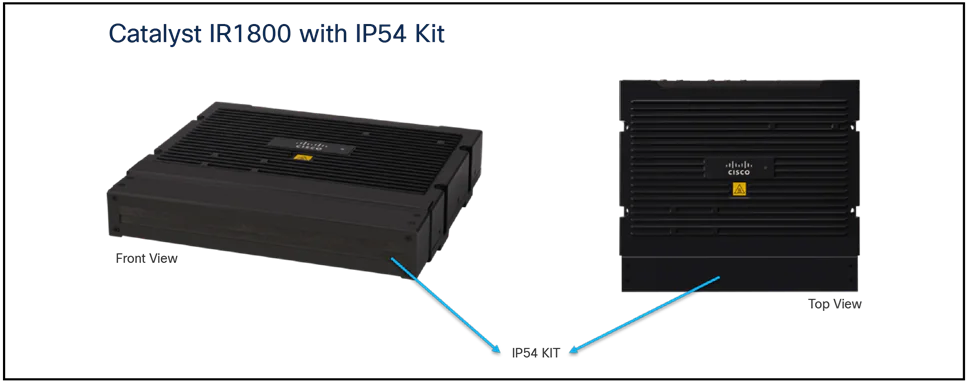
Catalyst IR1800 with IP54 kit
M12 kit
The IR1800 router can be used in Mass-Transit use cases such as railways and buses requiring M12 connectors using the optional M12 Conversion Kit. The kit comes with the front M12 Adapter assembly as well as the IP54 kit. This improves the IP rating of the whole unit to IP54 and makes the unit EN50155 compliant for railways and bus use cases.
The kit is made of die cast aluminum with paint and texture matching the IR1800 chassis. It includes:
● 1 M12 GE Copper Uplink
● 4 M12 GE LAN Ports
● 1 RS232/485* M12 port
● 1 GPS / GNSS SMA connector
● 1 M12 T-code power / CANBUS connector
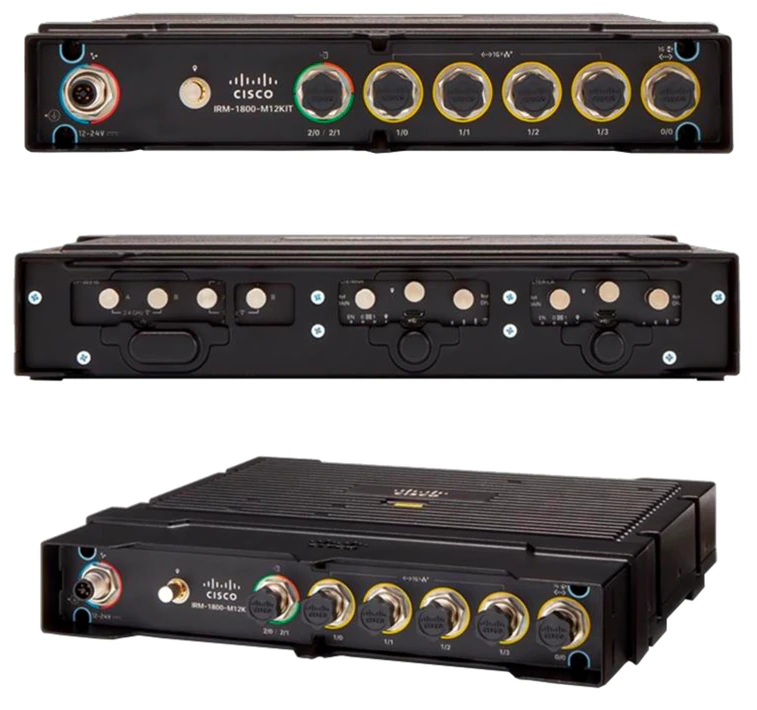
Table 16. M-12 Connector Kit
|
PID |
Description |
|
IRM-1800-M12KIT |
M12 Conversion Kit for IR1800 |
|
IRM-1800-M12KIT= |
M12 Conversion Kit for IR1800 - Spare |
Software details and management options
Software details
The Catalyst IR1800 Series runs on Cisco’s latest ultra-secure Cisco IOS XE. The table below details key features of Cisco IOS XE on the IR1800.
Table 17. Software details
|
Feature |
Description |
|
Cisco IOS Software requirements |
● Cisco IOS XE Software: Universal Cisco IOS Software image
● Cisco IOS XE Software Release 17.5.1 or later
● Cisco IOS XE Software: Unified image for Autonomous and Controller (SD-WAN) mode
|
|
IPv4 and IPv6 services features |
● Routing Information Protocol Versions 1 and 2 (RIPv1 and RIPv2) and RIPng (IPv6)
● Generic Routing Encapsulation (GRE) and Multipoint GRE (MGRE)
● Standard 802.1d Spanning Tree Protocol (STP)
● Network Address Translation (NAT)
● Dynamic Host Configuration Protocol (DHCP) server, relay, and client for IPv4 and IPv6
● Dynamic DNS (DDNS)
● DNS proxy
● DNS spoofing
● Access Control Lists (ACLs) for IPv4 and IPv6
● IPv4 and IPv6 multicast
● IP Service-Level Agreement (IP SLA)
● Open Shortest Path First (OSPF) v2 and v3
● Multiprotocol Border Gateway Protocol (MP-BGP)
● Enhanced Interior Gateway Routing Protocol (EIGRP) for IPv4 and IPv6
● Virtual Route Forwarding (VRF) Lite
● Next-Hop Resolution Protocol (NHRP)
● Asynchronous serial data encapsulation and relay
● Layer 2 Tunneling Protocol (L2TP) v3 over subinterfaces and VLAN
● Forward Error Correction (FEC) & Packet Duplication (With Catalyst SD-WAN Fabric Mode)
|
|
Security features |
Secure connectivity ● Trusted Anchor Module (TAM)
● Hardware-accelerated encryption with minimal impact to system performance
● Next-Generation Encryption (NGE) and Quantum Computing Resistant (QCR) algorithms such as AES- 256, SHA-384, and SHA-512
● Public-Key Infrastructure (PKI) support
● 20 IPsec tunnels
● NAT transparency
● Dynamic Multipoint VPN (DMVPN)
● Tunnel-less Group Encrypted Transport VPN (GETVPN)
● Flex VPN
● IPsec stateful failover
● Secure Sockets Layer (SSL) VPN for secure remote access
● VRF-aware IPsec
● IPsec over IPv6
Cisco IOS Firewall
● Zone-based policy firewall
● VRF-aware stateful inspection routing firewall
● Stateful inspection transparent firewall
● Advanced application inspection and control
● Secure HTTP (HTTPS), FTP, and Telnet Authentication Proxy
● Dynamic and static port security
● Firewall stateful failover
● VRF-aware firewall
Integrated threat control
● Control-Plane Policing (CoPP)
● Flexible packet matching
● Network foundation protection
Cisco Umbrella
● As supported by IOS-XE
● Advanced SD-WAN security features supported on IR1835
|
|
Quality of Service (QoS) features |
● Provides LTE QoS with support for up to 8 concurrent bearers on each cellular WAN interface for traffic classification and prioritization
● Provides traffic precedence to delay-sensitive and mission-critical services
● Facilitates low-latency routing of delay-sensitive industrial applications
● Supported on all LAN and WAN interfaces, including cellular
● Low Latency Queuing (LLQ)
● Weighted Fair Queuing (WFQ)
● Class-Based WFQ (CBWFQ)
● Class-Based Traffic Shaping (CBTS)
● Class-Based Traffic Policing (CBTP)
● Policy-Based Routing (PBR)
● Class-Based QoS MIB
● Class of Service (CoS) to Differentiated Services Code Point (DSCP) mapping
● Class-Based Weighted Random Early Detection (CBWRED)
● Resource Reservation Protocol (RSVP)
● Real-Time Transport Protocol (RTP) header compression (cRTP)
● Differentiated Services (DiffServ)
● QoS pre-classify and pre-fragmentation
|
|
High-availability features |
● Dual active LTE backhaul
● Virtual Router Redundancy Protocol (VRRP) (RFC 2338)
● Hot Standby Router Protocol (HSRP)
● Dual SIM support on the LTE module for cellular failover
● WAN monitoring to handle dual-SIM failover
|
|
IPv6 features |
● IPv6 addressing architecture
● IPv6 unicast and multicast forwarding
● IPv6 ACLs
● IPv6 over cellular, including DHCP Prefix Delegation
● IPv6 routing (Static, RIPng, OSPFv3, EIGRP, MP-BGP)
● IPv6 domain name resolution
● IPv6 DHCP services
|
The Catalyst IR1800 supports multiple management solutions to deploy and manage large-scale deployments at their various stages.
Table 18. Supported management solutions
|
Operational phase |
Application |
Description |
|
Device staging and configuration for a few routers |
Cisco WebUI |
A GUI-based device-management tool that simplifies provisioning of devices for a small-scale deployment through easy-to-use wizards. |
|
Secure and manage your distributed OT WAN assets with agility at massive scale using Catalyst SD-WAN Manager |
Cisco Catalyst SD-WAN Manager |
Gain comprehensive security ● Zero-trust approach and end-to-end security stack helps customers achieve segmentation, threat protection, content filtering, and more.
Scale with confidence ● IT network management solutions that scale to tens of thousands of devices with centralized security, policy and configuration.
Simplify IT and OT collaboration and save costs ● Give OT the best of IT with easy to deploy templates, centralized policies, remote updates, and application aware routing to reduce backhaul costs.
|
|
Extend your enterprise network to configure, monitor, and manage industrial assets |
Cisco Catalyst Center |
● Cisco Catalyst Center offers a network infrastructure that is not only fully programmable and open to third–party innovation, but can also fully and seamlessly integrate the cloud as an infrastructure component.
● Simplifies and automates processes and workflow by bringing the notion of user-aware and application–aware policies into the foreground of network operations.
● With Cisco Catalyst Center, the network can provide continuous feedback to simplify and optimize network operations.
● Single management dashboard for configuration and management of WAN.
|
The Catalyst IR1800 supports multiple embedded management capabilities.
Table 19. Embedded management capabilities
|
Feature |
Description |
|
Cisco IOS Embedded Event Manager (EEM) |
A distributed and customized approach to event detection and recovery. Provides the ability to monitor events and take corrective or any other desired action when the monitored events, such as a high or low threshold, occur. |
|
Cisco IOS XE IP SLA |
Helps assure the performance of new, business-critical IP applications as well as IP services by actively monitoring and reliably reporting traffic statistics such as jitter, response time, packet loss, and connectivity. |
|
Simple Network Management Protocol (SNMP), Syslog, NetFlow |
Open-standards-based network monitoring and accounting tools, such as SNMP for 3G, 4G, ignition power, ADR-GNSS, mSATA, etc., provide a common management platform for many different devices. |
|
LTE network management and diagnostics |
A dedicated diagnostic port on a cellular module enables logging of data during debugging sessions that can be analyzed by industry-standard tools such as Spirent Universal Diagnostic Monitor (UDM). |
|
Cisco IOS XE telemetry/YANG model |
Telemetry is an automated communications process by which measurements and other data are collected at remote or inaccessible points and transmitted to the receiving equipment for monitoring. Telemetry provides a mechanism to stream YANG-modeled data to a data collector. |
Software licensing
The Catalyst IR1800 introduces a dual network stack along with throughput licenses. Appropriate combinations can be selected according to need.
Network stack
There are two network stacks:
● Network Essentials
● Network Advantage
These stacks provide various capabilities. The Network Essentials license offers the essential elements of routing and security necessary for typical IoT deployments. The Network Advantage license enables advanced features such as MPLS, L2TPv3 for a highly scalable and cost-effective solution, mobile IP for seamless migration between networks, and application-aware QoS policies for built-in intelligence, in addition to the features offered by Network Essentials. The Network Advantage license also entitles users to Cisco Edge Intelligence, starting in EI Release 2.0.
The figure below explains the capabilities provided by the licenses.
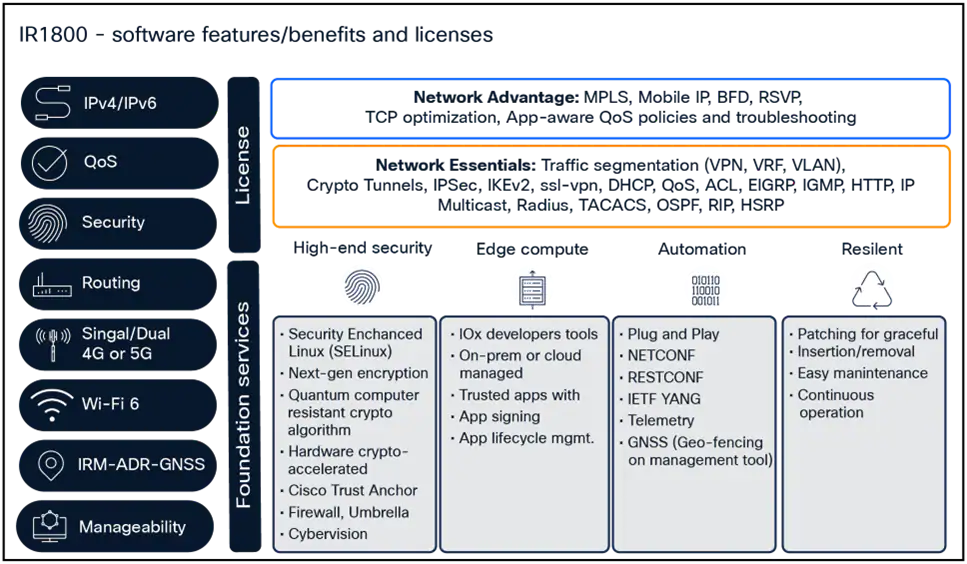
Licensing details
Throughput licenses
The IR1800 has three throughput license options.
Table 20. Licenses and throughput
|
License |
Tier |
Aggregate throughput |
Comment |
|
Default (DEF) |
T0 |
50 Mbps |
This is the default tier with 50 Mbps aggregate throughput. |
|
Performance (PERF) |
T1 |
250 Mbps |
This tier provides 250 Mbps aggregate throughput. |
|
Uncapped (UNC) |
T2 |
Uncapped |
This tier allows the device to use its full hardware capacity. |
Select an appropriate combination of network stack and throughput tier based on your requirements.
Export regulations require HSEC license as a mandatory attach with Boost License.
A single Cisco IOS XE universal image encompassing all functions is delivered with the product. Software feature licenses are preinstalled at the factory, depending on the selection made at the time of purchase, simplifying software delivery and decreasing the operational costs of the deployment. Licenses can be upgraded after deployment by going through the Cisco Smart License activation process. .
Ordering information
Ordering the Catalyst IR1800 can be divided into three major sections:
1. Operating system and licenses (step 2)
2. Pluggable modules (steps 3 through 7)
3. Accessories (step 8 and later)
To place an order, select the right product IDs from the tables below in sequential order.
Table 21. Product ordering process
Step 1. Select the base platform.
|
Hardware (chassis) |
Description |
|
IR1833-K9 |
Cisco Catalyst IR1833 Rugged Router |
|
IR1835-K9 |
Cisco Catalyst IR1835 Rugged Router |
Step 2. Select the network stack and throughput tier.
|
Licenses |
|||
|
Network Essentials |
Network Advantage |
Throughput tier |
Aggregate throughput |
|
SL-1800-NE/DEF-K9 |
SL-1800-NA/DEF-K9 |
T0 (default) |
50 Mbps |
|
SL-1800-NE/PERF-K9 |
SL-1800-NA/PERF-K9 |
T1 (Performance) |
250 Mbps |
|
SL-1800-NE/UNC-K9 |
SL-1800-NA/UNC-K9 |
T2(UNC) |
Uncapped |
|
Spare Licenses |
|||
|
Network Essentials |
Network Advantage |
Throughput tier |
Aggregate throughput |
|
SL-1800-NE/DEF-K9= |
SL-1800-NA/DEF-K9= |
T0 (default) |
30 Mbps |
|
SL-1800-NE/PER-K9= |
SL-1800-NA/PER-K9= |
T1 (Performance) |
250 Mbps |
|
SL-1800-NE/UNC-K9 |
SL-1800-NA/UNC-K9 |
T2(UNC) |
Uncapped |
The T2 (Boost) and T2 (Uncapped) license requires an additional mandatory L-18-HSEC-K9 license.
Step 3. Select the cellular pluggable modules.
|
Cellular module |
Description |
|
P-5GS6-RC-GL (=) |
5G Reduced Capbility module for North America, LATAM, Europe and Asia Pacific |
|
P-5GS6-R16SA-GL(=) |
Standalone / non-standalone 5G Sub 6 GHZ module |
|
P-LTEA7-NA(=) |
Category 7 LTE module for North America |
|
P-LTEA7-EAL(=) |
Category 7 LTE module for Europe, LATAM, Australia, New Zealand, India, Singapore, Malaysia, Thailand and United Arab Emirates |
|
P-LTEA7-JP(=) |
Category 7 LTE module for Japan |
|
P-LTE-GB(=) |
Category 4 LTE module for Europe |
Step 4. Select the option of a preinstalled Verizon SIM card (if required).
|
Verizon SIM card |
Description |
|
LTE-SIM-VZ(=) |
Verizon SIM (preinstalled) for zero-touch deployment |
Step 5. Select the Wi-Fi 6 pluggable module.
|
Wi-Fi 6 pluggable module |
||
|
CAPWAP mode |
EWC mode |
Description |
|
WP-WIFI6-x(=) |
WP-WIFI6-EWC-x(=) |
Wi-Fi 6 can be shipped in CAPWAP mode or Embedded Wireless Controller (EWC) mode based on the product ID selected ‘x’ denotes the country/regional code for Wi-Fi frequency (e.g., A/B/C, etc.) Wireless LAN Compliance Lookupcan be used to choose the right country/regional code |
Step 6. Select the dead reckoning pluggable GNSS module (IR1833-K9 and IR1835K9).
|
Dead reckoning GNSS |
Description |
|
IRM-GNSS-ADR(=) |
Dead reckoning GNSS pluggable module |
Step 7. Select the additional 100-GB SSD module (IR1833-K9 and IR1835-K9).
|
SSD |
Description |
|
IRM-SSD-100G(=) |
100-GB industrial-grade field-replaceable SSD |
Step 8. Select the power adapter and appropriate mating cord (if using a power brick and power cable).
|
Power supply and cables |
Description |
|
PWR-MF4-125W-AC(=) |
AC to DC power adapter for IR1800- 125W |
|
IR-PWR-G2A-NA(=) |
Power Cord - North America |
|
IR-PWR-G2A-BR(=) |
Power Cord - Brazil |
|
IR-PWR-G2A-AU(=) |
Power Cord – Australia |
|
IR-PWR-G2A-CE(=) |
Power Cord – Central Europe |
|
IR-PWR-G2A-ISR(=) |
Power Cord – Israel |
|
IR-PWR-G2A-ID(=) |
Power Cord - India |
|
IR-PWR-G2A-UK(=) |
Power Cord - United Kingdom |
|
IR-PWR-G2A-ITA(=) |
Power Cord – Italy |
|
IR-PWR-G2A-AR(=) |
Power Cord – Argentina |
|
IR-PWR-G2A-JP(=) |
Power Cord – Japan |
|
IR-PWR-G2A-AP(=) |
Power Cord – Asia Pacific |
|
IR-PWR-G2A-CN(=) |
Power Cord – China |
|
IR-PWR-G2A-SA(=) |
Power Cord – South Africa |
|
IR-PWR-G2A-SWI(=) |
Power Cord - Switzerland |
Step 9. Select the right OBD-II cable, if needed
(An OBD-II cable can be used to power the IR1800 from the OBD-II port of a vehicle, along with connecting to the CAN bus of the vehicle for vehicle data.)
|
OBD-II cable |
Description |
|
OBD2-J1962YA-MF4(=) |
OBD-II (J1962) Type A to IR1800 cable with type 1 Y-splitting bypass harness |
|
OBD2-J1939Y2-MF4(=) |
OBD-II (J1939) Type 2 heavy duty diagnostic harness for Volvo/Mack |
|
OBD2-J1939Y1-MF4(=) |
OBD-II (J1939) Type 1 to IR1800 cable with type 1 y-splitting bypass harness and auxiliary (discrete voltage) inputs |
Step 10. Select the right antennas and antenna stand for the use case/deployment.
|
Antenna |
Description |
|
ANT-7-5G4WL2G1-O(=) |
7-in-1 outdoor vehicle mount antenna- 4G LTE SMA x4, Wi-Fi dual band RP-SMA x2, GNSS SMA x1 |
|
LTE-ANTM2-SMA-D(=) |
4G LTE dipole antenna 698-960, 1448-1511, 1710-2690 MHz, SMA |
|
5G-ANTM-SMA-D(=) |
5G Sub-6 & LTE Advanced Pro capable dipole antenna, SMA |
|
W-ANTM2050D-RPSMA(=) |
Wi-Fi dual band swivel dipole antenna, RP-SMA |
|
ANT-4G-OMNI-OUT-N(=) |
Outdoor omnidirectional 4G antenna, N connector, 698-3800 MHz |
|
ANT-5G-OMNI-OUT-N(=) |
Outdoor omnidirectional 617 – 5950 MHz antenna, N connector |
|
4G-LTE-ANTM-O-3-B(=) |
3-in-1 outdoor black antenna, 4G LTE SMA x2, GPS SMA x1 |
|
ANT-3-4G2G1-O(=) |
3-in-1 outdoor antenna- 4G LTE TNC x2, GPS SMA x1 |
|
ANT-2-4G2-O(=) |
2-in-1 outdoor vehicle mount antenna- 4G LTE TNC x2 |
|
ANT-5-4G2WL2G1-O(=) |
5-in-1 outdoor vehicle mount antenna- 4G LTE TNC x2, Wi-Fi dual band RP-TNC x2, GPS SMA x1 |
|
5G-ANTM-O-4-B(=) |
9-in-1 outdoor antenna- 5G Sub-6 GHz / 4G LTE SMA x4, Wi-Fi dual band RP-SMA x4, GPS SMA x1 |
Step 11. Select the DIN rail (if using a DIN rail mount).
|
Mounting option |
Description |
|
IR1800-DINRAIL(=) |
DIN rail mount |
Step 12. Select the IP54 Kit (if you require an IP54 system).
|
IP54 option |
Description |
|
IR1800-IP54-KIT(=) |
IP54 Kit for IR1800 |
Step 13. Select the appropriate SFP module (if needed).
|
Ethernet SFP |
Distance |
Fiber |
Classification |
|
GLC-SX-MM-RGD |
220 to 550 m |
MMF |
Industrial (-40C to +85C) |
|
GLC-LX-SM-RGD |
550 m to 10 km |
MMF/SMF |
Industrial (-40C to +85C) |
|
GLC-ZX-SM-RGD |
70 km |
SMF |
Industrial (-40C to +85C) |
|
GLC-SX-MMD |
220 to 550 m |
MMF |
Extended (-5C to +85C) |
|
GLC-LH-SMD |
550 m to 10 km |
MMF/SMF |
Extended (-5C to +85C) |
|
GLC-ZX-SMD |
70 km |
SMF |
Extended (-5C to +85C) |
|
GLC-BX-U |
10 km |
SMF |
Commercial (0C to +70C) |
|
GLC-BX-D |
10 km |
SMF |
Commercial (0C to +70C) |
|
GLC-LH-MMD |
550 m to10 km |
MMF/SMF |
Extended (-5C to +85C) |
|
GLC-EX-SMD |
40 km |
SMF |
Extended (-5C to +85C) |
|
GLC-FE-100FX-RGD |
2 km |
MMF |
Industrial (-40C to +85C) |
|
GLC-FE-100LX-RGD |
10 km |
SMF |
Industrial (-40C to +85C) |
|
GLC-FE-100FX |
2 km |
MMF |
Commercial (0C to +70C) |
|
GLC-FE-100LX |
10 km |
SMF |
Commercial (0C to +70C) |
|
GLC-FE-100EX |
40 km |
SMF |
Commercial (0C to +70C) |
|
GLC-FE-100ZX |
80 km |
SMF |
Commercial (0C to +70C) |
|
GLC-FE-100BX-U |
10 km |
SMF |
Commercial (0C to +70C) |
|
GLC-FE-100BX-D |
10 km |
SMF |
Commercial (0C to +70C) |
|
GLC-TE |
100 m |
NA (RJ-45) |
Extended (-5C to +85C) |
Step 14. Select other accessories as needed.
|
Other accessories |
Description |
|
Power cable |
|
|
CAB-PWR-15-MF4 |
Power cable when directly connecting to a DC source (such as a vehicle battery) Note: It is preferred to use an OBD-II cable for a quick and clean installation |
|
RF cables |
|
|
CAB-L240-10-SM-TM |
SMA(m)-straight to TNC(m)-straight, LMR-240-DB, 10 ft. |
|
CAB-L240-15-SM-TM |
SMA(m)-straight to TNC(m)-straight, LMR-240-DB, 15 ft. |
|
CAB-L240-20-SM-TM |
SMA(m)-straight to TNC(m)-straight, LMR-240-DB, 20 ft. |
|
LTE-AE-MAG-SMA |
Magnetic SMA antenna stand, SMA(f)-straight to TNC(f)-straight, LMR-195 plenum rated, 1 ft. |
|
CAB-L240-10-SM-NM |
SMA(m)-straight to N(m)-straight, LMR-240-FRDB, 10 ft. |
|
CAB-L-10-RSP-RTP |
RP-SMA(male) to RP-SMA(female), 10 ft. |
|
CAB-L195-10-SM-SF |
SMA(m) to SMA(f), LMR-195, 10 ft. |
|
CAB-L240-20-SM-SF |
SMA(m) to SMA(f), LMR-240, 20 ft. |
|
CAB-L400-20-N-N |
N(m)-straight to N(m)-right angle, LMR-400-DB, 20 ft. |
|
RF adapters |
|
|
LTE-ADPT-SM-TF |
SMA(m)-straight to TNC(f)-straight adapter |
|
AIR-ACC370-NF-NF |
N(f)-straight to N(f)-straight adapter |
|
Ethernet cable |
|
|
CAB-ETH-S-RJ45 |
Yellow Cable for Ethernet, Straight through,RJ-45,15 feet |
|
Console cable |
|
|
CAB-USB-UB |
USB Type A to USB Micro-B (2m) |
|
Digital I/O cable |
|
|
CAB-IO-MF6 |
Mating connector for Alarm-In / Digital I/O / Ignition Sense |
|
Lighting arrestors |
|
|
ACC-LA-G-SM-SF |
SMA(m) to SMA(f)- straight, GDT, DC to 6 GHz |
|
CGR-LA-NF-NF |
N(f)-straight to N(f)-straight, GDT, DC to 6 GHz |
|
CGR-LA-NM-NF |
N(f)-straight to N(m)-straight, GDT, DC to 6 GHz |
|
4G-ACC-OUT-LA |
TNC(f)-straight to TNC(m)-straight, HPF, 698 to 2700 MHz (does not support GNSS) |
|
ACC-LA-G-TM-TF |
TNC(f)-straight to TNC(m)-straight, GDT, DC to 6 GHz |
For more information
Learn more about the Cisco Catalyst IR1800 Rugged Series Routers: https://www.cisco.com/go/IR1800
Learn more about the industrial routing portfolio:
https://www.cisco.com/c/en/us/solutions/internet-ofthings/iot-routers-and-gateways.html.
Footnotes Reference
| IR1835-K9 | |
| Cisco 800 Series | |
| Cisco 800 Series Chassis | |
| Cisco Catalyst IR1835 Rugged Series Router | |
| 3,015.00 | |
| 2021-08-09 |